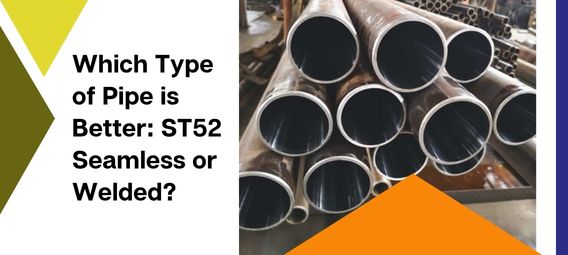
Selecting the wrong industrial steel pipe grade doesn’t just create a procurement problem :it creates a performance problem that shows up under load, under pressure, or at exactly the wrong moment in the field. ST52 steel commands growing demand across hydraulic systems, construction frameworks, oil and gas pipelines, and heavy engineering precisely because it delivers the load-bearing capacity that standard carbon steel grades can’t match. But once you’ve confirmed the grade, you face a second decision that trips up buyers regularly: seamless or welded? Neither type automatically wins. The right answer depends on operating pressure, failure consequence, available budget, and the service environment the pipe will actually face. This comparison builds the engineering case for each.
What is the ST52 Pipe?
ST52 is a high-strength low-alloy structural steel grade. It’s specified in mechanical, structural, and general engineering systems where standard carbon steel doesn’t deliver enough load-bearing capacity. The ST52 steel pipe grade is ideal for welding and is reliable under mechanical influence. It is one of the most prevalent grades stated across European engineering standards and is a direct equivalent to grades such as S355 in EN classification.
What is the ST52 Seamless Pipe?
ST52 is a high-strength low-alloy structural steel grade that engineers specify in mechanical, structural, and general engineering systems where standard carbon steel falls short on load-bearing capacity. The European equivalent runs under EN S355 classification. Both designations cover the same performance territory: weldable, reliable under mechanical load, suited for precision engineering and structural work alike.
For complete information on ST52 Seamless Pipe, including pressure ratings, dimensions, and tolerance specifications, the full product documentation covers the technical picture.
Understanding the Dimensions and Uses of ST52 Seamless Pipe before specifying matters because wall thickness uniformity :a direct product of the seamless manufacturing method :determines real-world pressure-holding capability.
- No welded joints :the material structure holds consistent throughout the full circumference
- Pressure-holding capability exceeds welded equivalents at the same wall thickness
- Preferred for hydraulic systems, oil lines, and any application where a joint failure has serious downstream consequences
- ST52 seamless pipe properties hold consistently across the full cross-section because the material never passed through a weld heat-affected zone
What is an ST52 Welded Pipe?
Welded pipes begin as flat steel strip. Roll the strip into a cylinder, seam-weld the edge :that’s the process. Faster to produce than seamless, cheaper per metre, and available in larger diameters that seamless manufacturing would struggle to deliver economically.
For general structural work and industrial applications that don’t face extreme operating pressure, ST52 welded pipes deliver exactly what the project needs without over-specifying.
- Economical: lower material and production cost versus seamless at equivalent diameter
- Available in large sizes: the welding process suits large-diameter production that seamless can’t match cost-effectively
- Good for low to medium pressure: suited for structural members, water distribution lines, and general industrial fluid systems
- Faster lead times: high-volume manufacturing suits project timelines on large-scale structural supply
Key Differences Between Seamless and Welded ST52 Pipes
The distinction between these two types runs deeper than just manufacturing method. It drives pressure performance, weld zone integrity, size range, cost, and suitable application.
- Wall integrity: Homogeneous mechanical properties over the full circumference in seamless pipes; weld seam as a potential fatigue initiation point under cyclic loading in welded pipes
- Pressure rating: Seamless can resist a higher working pressure for the same wall thickness and diameter, as there is no weld zone to weaken the cross section
- Fatigue resistance: Seamless is better than welded in the case of applications with cyclic pressure change. Stress concentration occurs in weld zone of welded pipe under repetitive load.
- Size range: Welded manufacturing suits large diameters (above 500mm) more economically; seamless dominates in smaller, precision-toleranced diameters
- Surface finish and dimensional tolerance: Seamless achieves tighter tolerances on wall thickness eccentricity, which matters in precision-machined components and hydraulic bore applications
- Cost differential: Seamless typically costs 15–30% more than equivalent welded pipe; the premium is justified where pressure performance or fatigue life demands it, not by default
- Weld inspection requirements: Welded pipe requires NDT weld seam inspection for pressure-rated applications; seamless eliminates this inspection requirement and the associated procurement overhead
- Availability: Welded pipe holds broader stock availability in standard sizes; seamless supply benefits from specialist stockists
Application-Based Comparison
What the pipe actually faces in service determines which type fits. A hydraulic line running at high pressure in heavy machinery needs different characteristics than a structural column in a building frame.
- Hydraulic systems → seamless, for pressure integrity and fatigue resistance through cyclic loading
- Oil and gas pipelines → seamless for pressure-rated flow lines; welded for lower-pressure gathering systems
- Heavy machinery components → seamless where bore tolerances are critical to component fit
- Construction frameworks → welded, where structural load governs and pressure performance is secondary
- Water distribution pipelines → welded, where operating pressures stay within the welded pipe’s capability
- Structural members → welded, for cost-effective supply at the larger diameters structural work demands
Industry-Specific Usage of ST52 Pipes
- Construction → welded pipes for structural columns, beams, and framework members
- Automotive → seamless pipes for precision hydraulic and mechanical components where bore concentricity affects system performance
- Oil and gas → seamless for pressure-rated flow lines and wellhead connections; welded for lower-pressure infrastructure
- Engineering plants → both types, depending on system pressure rating and failure consequence at each specific connection point
Advantages of ST52 Seamless Pipes
- High pressure resistant: without stress concentration point like weld seam under load
- Material properties are uniform: no disruption of weld heat-affected zone
- Increased fatigue resistance: important for hydraulic systems operating under cyclic pressure duty
- Trusted in hydraulic, oil, and gas, and precise engineering applications where joint failure has catastrophic effects.
Advantages of ST52 Welded Pipes
- Lower cost per metre for general structural and civil applications
- Faster production and broader availability in standard and large diameters
- Suitable for large-scale projects where structural load governs and the pressure rating is moderate
- Flexible sizing :the welding process produces non-standard dimensions more readily than seamless
Which One is Better?
Seamless wins where pressure performance, fatigue resistance, and safety criticality govern the specification. Welded wins where structural load, large diameter, cost sensitivity, and broad availability drive procurement decisions. Both use ST52 grade steel :the manufacturing method, not the grade, determines which belongs in which application.
- Seamless → performance-critical use where pressure, safety, or fatigue resistance come first
- Welded → economically viable for general applications where structural load and budget matter more than pressure rating
- Selection depends on → operating pressure, consequence of failure, project budget, and required diameter range
Why Choose Rexton Steel & Alloys for ST52 Pipes
Rexton Steel & Alloys stocks ST52 seamless and welded pipes across a broad dimensional range for structural, mechanical, and pressure-rated applications across global engineering sectors. Every pipe ships with quality testing records, traceable material documentation, and dimensional certification.
Construction, automotive, and oil and gas industries receive piping systems matched to their project specifications, with competitive pricing and fast dispatch from maintained stock.
Conclusion
ST52 seamless pipes handle the demanding end :high pressure, critical systems, long service life under cyclic loading. ST52 welded pipes handle the practical end :larger diameters, cost-sensitive projects, general structures. Specify the right type from a verified source with documented material traceability, and the pipe performs for the full life of the system without unexpected maintenance.